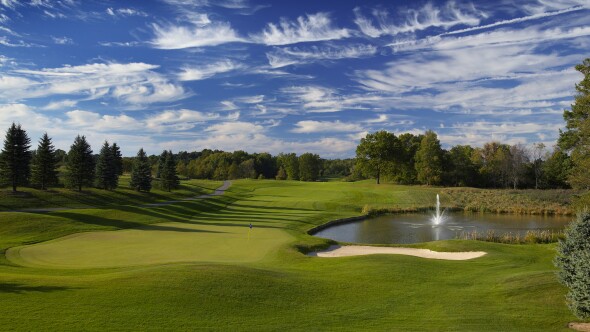
Scovill Golf Club

This golf course is closed for business. Not true? Let us know.
Looking for other options nearby?
Rating Snapshot


About
Editor's Note: Course closed for business in 2017.
| Tee | Par | Length | Rating | Slope |
|---|---|---|---|---|
| Blue | 71 | 5925 yards | 68.4 | 119 |
| White | 71 | 5255 yards | 65.4 | 112 |
| Gold | 71 | 4832 yards | 63.5 | 107 |
| Green (W) | 71 | 4303 yards | 64.5 | 106 |
| Hole | 1 | 2 | 3 | 4 | 5 | 6 | 7 | 8 | 9 | Out | 10 | 11 | 12 | 13 | 14 | 15 | 16 | 17 | 18 | In | Total |
|---|---|---|---|---|---|---|---|---|---|---|---|---|---|---|---|---|---|---|---|---|---|
| Blue M: 68.0/115 W: 73.2/121 | 475 | 390 | 165 | 460 | 186 | 365 | 380 | 320 | 117 | 2858 | 455 | 165 | 270 | 505 | 515 | 416 | 203 | 300 | 238 | 3067 | 5925 |
| White M: 65.0/108 | 420 | 361 | 130 | 392 | 170 | 343 | 296 | 290 | 104 | 2506 | 381 | 145 | 254 | 464 | 474 | 347 | 168 | 292 | 224 | 2749 | 5255 |
| Gold M: 63.1/103 W: 67.1/108 | 410 | 328 | 130 | 382 | 170 | 266 | 286 | 270 | 104 | 2346 | 318 | 140 | 239 | 338 | 464 | 347 | 158 | 258 | 224 | 2486 | 4832 |
| Green W: 64.1/102 | 374 | 318 | 113 | 318 | 157 | 256 | 235 | 228 | 90 | 2089 | 308 | 112 | 229 | 336 | 370 | 269 | 134 | 248 | 208 | 2214 | 4303 |
| Handicap | 7 | 1 | 15 | 9 | 13 | 5 | 3 | 11 | 17 | 2 | 18 | 14 | 8 | 4 | 6 | 10 | 12 | 16 | |||
| Par | 5 | 4 | 3 | 5 | 3 | 4 | 4 | 4 | 3 | 35 | 4 | 3 | 4 | 5 | 5 | 4 | 3 | 4 | 4 | 36 | 71 |
Course Details
Rentals/Services
Practice/Instruction
Policies
Available Facilities
Clubhouse, Banquet FacilitiesReviews
Reviewer Photos

Final round
This is an excellant and challenging course for the average player. Unfortunately Decatur Park District has chosen to close this course. They have made a sad decision that will effect the area golfing community for years to come. The other 2 courses in town are not near as accommodating to the average golfers. RIP Scovill Golf Course.
About to Close
The Decatur Park District is closing Scovill this fall. This unique central Illinois course has been there since the 1930s. While many people call it the "goat path" in derogatory terms, those of us who love the unusual aspects of the course call it that name affectionately. It will be missed by many.
Love this course and staff
I Love everything about this course and staff everyone is extremely friendly. Always a pleasure of seeing Joe for tips and help
excellent greens
I been playing this golf course for over 2 years now, and I was amazed that the greens were at it's best this year.
It looked like the green keeper were doing something different this year, but whatever it is, it is perfect. Well manicured greens with every hole, awesome.

Construction Superintendent
Great old course. Greens are great. Lots of interesting holes will probably use every ub in your bag
Good mix of par 5s and par3s
Better Hurry
This historic course with elevations and undulations unusual to central Illinois is scheduled to be closed this fall.
Please Save This Course
The Decatur Park District wants to close this golf course down at the end of this year. Please write the Board Members of the Decatur Park District to not shut down this course! Closing this course would leave only 2 in Decatur and that's not enough for a town that's trying to rebuild itself.

Ignore this course and you will regret.
Scovill is born superior than other Decatur courses nearby - Red Tail Run and Hickory Point. Tree lines are tall and mature. Dick Nugent renovated the course and he will not disappoint you. The rumor says that the course will be closed in 2018 so enjoy this hilly little fun course while you can.
I took one star off simply because the course is short and greens are sick on a few holes.
Construction Superintendent
Great old track, greens are great, great variety oh holes from short par 3's to hilly tough par 5's
Good day to get a round in, weather was great for first part of March. Actually played really well and could not beat the value from Golf now.
Such a shame
It's a shame that they are closing this course this year or next. It really is a great course for the money. Very challenging for a shorter course and definitely makes you stay straight on your drives. Wish they'd keep it open but that's the nature of the beast I guess. Golf is a dying sport anymore
Best Golf in the Fall Weather
Played 18 holes with my husband. We played the front nine twice as we didn't want to play the back. The greens were in very good shape although many players had not been fixing divots. The fairways were in very good shape also. The rangers were very pleasant and helpful. It was a perfect day for golf and very few people so we were able to take our time and enjoy.
Fun Course
The course was in average with some brown spots in the fairway. We played the ball up in the fairways and down the rest of the course and had a blast. Blind shots and rolling terrain makes for a great day.


The Best of The Lake Package
Ozarks Golf Around Package
SW Michigan Golf Around Package