


Ruffled Feathers Golf Club

Rating Snapshot


About
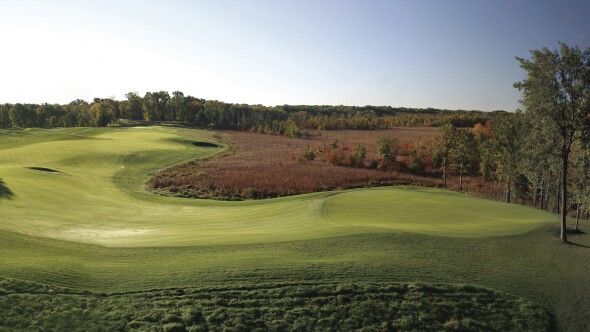
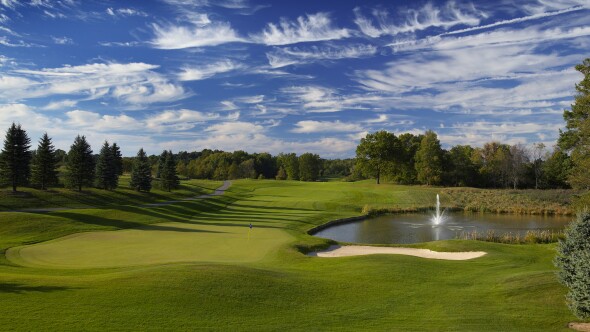
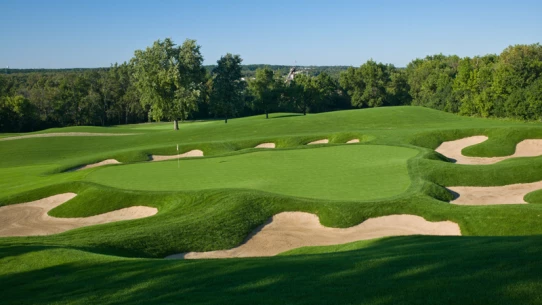
Ruffled Feathers Golf Club in Lemont is conveniently situated just a half hour outside downtown Chicago. Pete Dye and his son P.B. collaborated to design the course, making it the only Dye design in the Chicago area. A well thought-out strategy will be greatly rewarded on this challenging layout and bad shots made without any thought will be severely punished. This is definitely not a golf course where you can just grip it and rip it. The fairways are fairly straight and forgiving, but most of the approach shots play to tricky elevated greens. There are also strategically placed bunkers framing the greens and water hazards come into play on several holes as well. Ruffled Feathers Golf Club's par 3s have a reputation for being particularly challenging. But depending on how windy it is, the final hole might present the most formidable challenge.
| Tee | Par | Length | Rating | Slope |
|---|---|---|---|---|
| Championship | 72 | 6898 yards | 73.7 | 140 |
| Back | 72 | 6389 yards | 71.4 | 135 |
| Middle (W) | 72 | 6015 yards | 75.6 | 140 |
| Middle | 72 | 6015 yards | 69.5 | 130 |
| Forward (W) | 72 | 5273 yards | 71.5 | 131 |
| Junior | 72 | 4455 yards | 67.0 | 121 |
| Hole | 1 | 2 | 3 | 4 | 5 | 6 | 7 | 8 | 9 | Out | 10 | 11 | 12 | 13 | 14 | 15 | 16 | 17 | 18 | In | Total |
|---|---|---|---|---|---|---|---|---|---|---|---|---|---|---|---|---|---|---|---|---|---|
| Black M: 74.1/142 | 379 | 361 | 193 | 578 | 467 | 518 | 413 | 220 | 464 | 3593 | 403 | 155 | 380 | 510 | 328 | 510 | 336 | 221 | 462 | 3305 | 6898 |
| Blue M: 71.8/137 | 348 | 328 | 153 | 543 | 440 | 490 | 390 | 210 | 433 | 3335 | 385 | 140 | 317 | 471 | 301 | 470 | 316 | 212 | 442 | 3054 | 6389 |
| Gold M: 70.1/133 W: 75.7/138 | 341 | 302 | 135 | 527 | 414 | 455 | 373 | 166 | 427 | 3140 | 375 | 120 | 309 | 435 | 270 | 464 | 290 | 178 | 434 | 2875 | 6015 |
| Gray M: 66.7/125 W: 71.6/129 | 317 | 257 | 115 | 446 | 359 | 429 | 345 | 154 | 342 | 2764 | 316 | 102 | 274 | 405 | 251 | 402 | 267 | 145 | 347 | 2509 | 5273 |
| Handicap | 11 | 13 | 15 | 3 | 1 | 7 | 9 | 17 | 5 | 4 | 14 | 16 | 8 | 12 | 2 | 10 | 18 | 6 | |||
| Par | 4 | 4 | 3 | 5 | 4 | 5 | 4 | 3 | 4 | 36 | 4 | 3 | 4 | 5 | 4 | 5 | 4 | 3 | 4 | 36 | 72 |
Course Details
Rentals/Services
Practice/Instruction
Policies
Food & Beverage
Bar, CateringAvailable Facilities
Clubhouse, Banquet FacilitiesReviews
Reviewer Photos
-
Photo submitted by goodybank on 06/26/2023
-
Photo submitted by goodybank on 06/26/2023
-
Photo submitted by goodybank on 06/26/2023
-
Photo submitted by Fiddler71 on 06/05/2023
-
Photo submitted by rwtsang on 10/01/2021
-
Photo submitted by u314161153720 on 05/10/2021
-
Weeds growing all over a bunker Photo submitted by 6nkm7chAB4GXOL8PCerz on 08/22/2020
-
Par 3, 11th. Photo submitted by mleahy11 on 09/08/2013
-
Island Green Hole - Not looking so good. Photo submitted by leathtech on 07/22/2013
-
Drop zone really??? Photo submitted by leathtech on 07/22/2013

Thank you for the great rating. We’d love to know what made your experience great!
Ruffled Feathers
Excellent conditions considering we were playing in off-season. Anytime you can get out in February it’s a bonus. Greens and Fairways were in excellent condition. Bunkers could use a little work.
Thank you for the rating! We will keep your comments in mind in order to improve!
Not worth the money
Found a hot deal on Golf Now for $65 per person which included the cart for 11am on a Sunday. Not bad for a $100 plus course, however, the course was in bad condition. No started, no ranger and bunkers flooded, washed out, hardened and no rakes. Course is infested with geese. Great layout but needs a head greens keeper who would make Pete Dye proud of his design instead of letting it go to crap. Pro shop said there was a cart girl out on the course but did not see her until the 9th hole. My playing partner asked, “Where have you been?” And she responded, “It’s cold out!” They should stop charging so much money and get some more play and income coming in and get this course back to the way it was in the early 2000’s!!
A course in shambles
This used to be one of my favorite tracks.
I played 7 holes in 2:20 then walked off. The bunkers have no sand. There were no Marshals. They seemed to be much more concerned about their corporate shotgun start rather than the players already on the course.

Overall Good Course, but put out the tee boxes
For 110 dollars to play here you expect to play a course with multiple tee boxes, rather than combining the golds and the blues the course should take the time to set up the tee boxes correctly, black tee boxes are too long while the blue/golds are really just the golds. Also the bunkers were not well kept with multiple being flooded. Overall great course, but please take the time to set up tee boxes
Hi u3656825, thank you for your feedback and for choosing our course. We appreciate your input regarding the tee boxes and bunkers. Your comments will be shared with our team for future improvements. We're glad you enjoyed the overall experience and hope to welcome you back soon.
Ruffled Feathers
Liked the front 9. Thought the back was a little choppy. Course needs signs to take you around the place easier. Fairways were in good shape. Bunkers need a reclamation project with new sand put in. Would have liked a short game area and larger putting green. Space reserved for DePaul golf is wasted.
Disappointing
For the price point this was one of the worst courses I’ve played in the Chicago area. Bunkers were completely destroyed and and greens hadn’t seen a ball mark fixed in weeks. Pace of play was 5+ hours and the rangers didn’t feel like doing anything about it. Much nicer courses for the $$ in the area.
Hi u000007689774, thank you for your feedback. We apologize for your disappointing experience at our course. We appreciate your concerns regarding the condition of the bunkers and greens, as well as the pace of play. We value your input and will take it into consideration in our efforts to improve.
Terribly Maintained
For $110 this might be the worst course I have ever played. The carts are old and beaten up, the tee boxes are poorly maintained, the bunkers are the equivalent of hitting off the cart path, and the greens were in awful shape. Had multiple putts where my ball took large hops on the green because of old ball marks that were just never repaired. Really sad to have a pete dye course so poorly maintained.
Hi u972842574, we appreciate your feedback and we're sorry to hear about your experience. We strive to provide the best possible course conditions and will address your concerns with our team. Thank you for bringing this to our attention.
Better things to come hopefully
This has always been one of my favorite courses in the whole metro area. Unfortunately, played the day after a torrential rain. The bunkers were unplayable as they were still full of water. The rest of the course, however, was in surprisingly good shape. The cart paths, however, need a lot of work. I was pleased to hear from the pro shop staff that they plan to put a lot of money into the course during the off-season, including new drainage systems. Looking forward to seeing the results of the work.
Hi u000003680458, thank you for sharing your feedback. We appreciate your support and apologize for the inconvenience caused by the recent rain. We're glad to hear that the rest of the course was in good shape. We look forward to providing you with an even better experience next time!
Great layout challenging holes but lacking maintenance
First time at ruffled feathers. Had heard great things about this course and I was excited to finally play there. Fairways and greens were in good shape, bunkers and tee boxes not so much. Nearly every tee box had so many divots that it was hard to get good footing let alone find a place to put your tee. Tons of bunkers on the course which presents a challenge, but it’s an even harder challenge when the bunkers don’t have sand! Most of the bunkers on the course were overgrown and some didn’t have sand at all. For the price of near $100 for an afternoon tee time or over $100 for a weekend morning tee time. I feel the course is way below average for that price. For the same price you can go down the street to Cog Hill and play Ravines which is always on good shape.
Hi u314160741322, thank you for sharing your feedback. We apologize for the condition of the tee boxes and bunkers during your visit. We appreciate your input and will work on improving these areas. We hope you'll give us another chance in the future.
Ruffled Feathers is the Best
I was amazed to see the negative reviews of this course. . The negative reviewers don't have a clue.
I have played most of the finest private golf courses in Chicagoland together with many of the best resort courses in America. Ruffled Feathers is a GORGEOUS golf course. Unique Pete Dye design. Its is difficult -but its just beautiful.
And they maintain it like it is a private club course. It is also a superb value compared to places like Cantigny and the Glen. .
Great afternoon .
.
Hello u314162504240, We appreciate your positive feedback about your experience. We take pride in serving our customers and hope to see you again soon!
Course is great.
Playing here is great,had a hole in one on #11,made my day.
Congratulations santlonard on the Hole-in-One and thank you for the amazing review!
We’re thrilled to see you had a positive experience, santleonard. Care to share any details?
Run Down
I was excited to play the course but was meet with rough greens, geese feces everywhere, and overall poor maintenance for the price. I won't be coming back, which is a shame, because it has a cool layout.
u314161989754, thank you for the feedback. We are always looking for ways to increase customer satisfaction and will pass your comments along to management.
Bad Bunkers
Overall the course was good. The bunkers were AWFUL, with many of them being nothing more than dirt. Greens were in OK shape. The rest of the course was solid. I’m glad I got a “hot deal” as this kept me thinking it was worth the money. I would absolutely never pay full price for this place. It isn’t worth the $100+ they are asking on the weekend.
Thank you for the review u00000331036! We are aware of the conditions of the bunkers and hope to have good news regarding the bunkers soon.
Not being maintained as premium course
Worse greens I have experienced all summer. Pace of play was over 5 hours. Very limited rakes on course, most sand traps not maintained. This year they have combined the blue and gold tees, why. Other local course are in far better condition at a fraction of this price. If you want to consider yourself a premium course, it needs to be maintained as such
We’re sorry to hear about your experience, Michael6213720, but the feedback is appreciated. Our team will look into this. It is important that we take your feed back seriously, and will let our grounds crew know.
Thank you santleonard for the review!


SentryWorld Stay & Play Package

Destination Kohler - Champions' Trail Golf Package

Destination Kohler - To Dye Four Golf Package
SW Michigan Golf Around Package



docmuska, very sorry to see you had an unsatisfactory experience, but appreciate you taking the time to leave a review. Would you mind messaging us so that we can learn more about what we could be doing better?