COURSE
REVIEW
Lincoln Greens Golf
Course in Springfield:
Better than a night at
the theater
By Kiel Christianson,
Senior Writer
SPRINGFIELD, Ill. (July 5, 2005) - There's no evidence to suggest that Abraham Lincoln even knew what golf was, although, the year he became president, 1860, was also the inaugural year of the British Open at Prestwick.
As a voracious reader of newspapers, however, Lincoln might well have read of that event and might have wondered if his rail-splitting swing would serve to knock a feathery around the links.
|
Put another way, there's also no evidence to suggest that Lincoln didn't know what golf was. And given the fact that seemingly everything else in Springfield has some connection to Lincoln, it doesn't seem too outrageous that the one-time and soon-to-be-again showpiece of the city's municipal courses, Lincoln Greens Golf Course, should be named after The Great Emancipator.
Perhaps the name is even more fitting since the course's near assassination a few years ago, when nearly criminal neglect had killed off essentially all the turf and allowed the clubhouse to crumble.
The course opened in 1957 as part of the Springfield Recreation Department and flourished as long as the mayor and city commissioners were golfers. But when non-golfers took power, the money for maintenance dried up, along with the grass.
According to one course worker, "there was simply no grass" prior to the Springfield Park District's takeover of operations. Today, Head Professional Jim Sutzer, who concurs with the dire descriptions of the not-so-distant past course conditions, is striving to return Lincoln Greens to the position it once held in the local golf scene.
By all accounts, the improvements are truly remarkable. Don Woods, a recently retired attorney, life-long Springfield resident and 9-handicap, describes the course as "plush, like a country club" in the 1970s. And Sutzer recalls golfers driving up from St. Louis and sleeping in their cars overnight in the parking lot to assure a weekend tee time, a la Bethpage Black.
"My hope," Sutzer said, "is that people who remember what it was would come back again."
How it plays
Lincoln Greens sports completely new irrigation and drainage systems and work is continuing. Between holes 5 and 6, for example, a silt pond is being built for irrigation water to be pumped into before heading out into the system. The silt will settle in the pond, rather than clogging up the pipes.
Despite the flurry of recent improvements - including a brand new clubhouse, slated to be dedicated this month - conditioning issues still exist. This isn't surprising, considering the sad condition the track was in just three years ago.
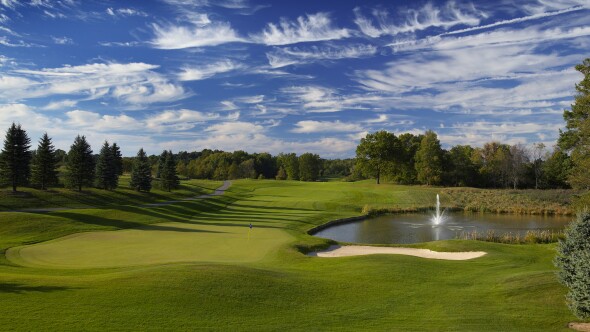
In spite of the occasional hard green, hardpan in the rough and dry patches in the fairways, Lincoln Greens today is well worth a visit. The course features the hallmarks of classic course design: elevated, small, back-to-front tilted putting surfaces and large, flash-faced greenside bunkers that sit 10 to 15 yards back from the edges of the greens.
This feature in particular had a practical side as well as a strategic purpose: It allowed the larger mowers of the time to pass between the bunkers and the greens.
From a strategic standpoint, the combination of hiding the putting surfaces from view behind these bunkers makes it appear that the greens are much closer than they actually are.
Woods and Sutzer offer the same basic advice to first-timers: Take more club than you think, because the bunkering is extremely deceptive. Woods tells of numerous first-timers he's played with here that have consistently come up short of the greens until they figure out the visual trickery.
One of the most pronounced examples of this illusory style of design is at the 382-yard seventh, where the bunkers make it look as if the putting surface begins at the crest of the hill. Instead, when you arrive at the top of that hill and walk past the bunkers, you discover that the green doesn't begin for another 25 yards - and you've got a tricky mid-length chip to contend with.
Another consequence of this bunkering style, which is still commonly found in Scotland and Ireland but has mostly fallen out of favor in the U.S., is the awkward length of bunker shots it leaves. In fact, most greenside bunker shots here will not be simple blast-outs. Instead, especially if the pin is back, you'll be faced with 20- to 40-yard bunker shots throughout your round - one of the most despised shots in all of golf.
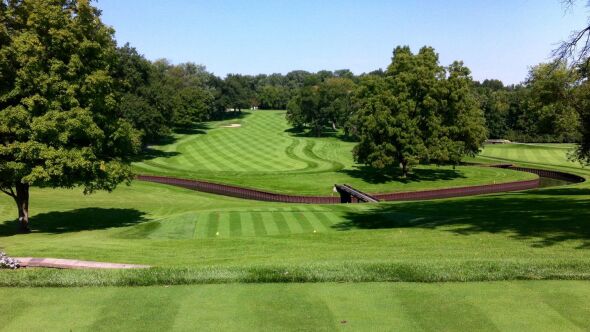
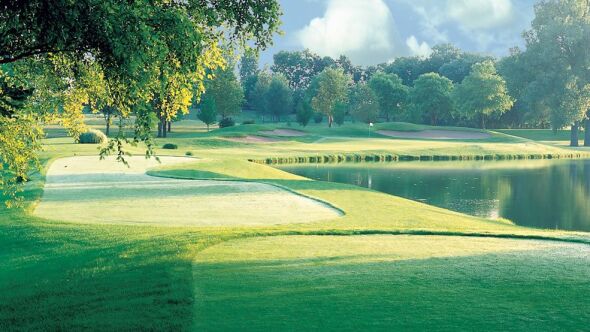
Arguably the two best holes on the course are the 414-yard, par-4 fifth, which plays downhill off the tee over a finger of Lake Springfield (the siltiest lake in the U.S., in which search-and-rescue teams from all over the world practice in the poor visibility). Long hitters need to be very careful here as a big drive will reach the water, while laying back forces an uncomfortably long carry over the water to the green.
The 230-yard 13th is a great par 3, where the small, steeply canted green is extremely well guarded by a generous collection of those signature deceptive bunkers. If you negotiate 13 well, your reward will come on the 375-yard 16th, which features an openness and right-to-left dogleg that allow you to take your biggest, hardest swing off the tee and get it as close at you can to the humpback green (then pretend you're at Pinehurst No. 2 when you're chipping on).
The verdict
Golfers willing to take a chance and return to this once-desolate track - or for first-time visitors to Springfield willing to try a new muni - will be pleasantly surprised by Lincoln Greens. The 6,819-yard layout will not overwhelm with length or difficulty (rating 71.1, slope 119), but neither will it disappoint with poor conditioning or lackluster design.
Although conditioning is still an issue in spots, Course Superintendent Jim Lamsargis has done an admirable job in reinvigorating the once plush track. Sutzer offers lessons on the range, which is due for expansion and improvement, too, and the "neighborhood course" feel of days gone by is being revived with shotgun outings open to everyone every Friday.
In short, Honest Abe would have enjoyed the blue-collar atmosphere and honest golf here. To paraphrase the oft-quoted mantra of mid-handicaps everywhere, "Even a bad day at Lincoln Greens is better than a night at the theater."
Places to stay
There are no specific stay-and-play packages, but at $20 for non-residents on weekdays and $22 on weekends (+ $10.50 to ride; $18 and $20 for residents), who needs discounts?
| ||||||||||
Places to eat
Everyone could use a deal on beer, though. Nearby Max's California Grill and Sportsbar offers golfers a $10 bucket of beer when you bring in your green fees receipt from Lincoln Green.
For solid food, my personal favorite is Café Brio downtown on 6th & Monroe ((217) 544-0574). It's also only a few blocks from Lincoln's Home and the State Capitol. Café Brio serves up Southwestern fusion/Mediterranean/Caribbean cuisine in a very funky mix-and-match sort of atmosphere. And the margaritas are the best in town.
Fast fact
The play showing at the Ford's Theatre the night Lincoln was assassinated was entitled "Our American Cousin."
Any opinions expressed above are those of the writer and do not necessarily represent the views of the management. The information in this story was accurate at the time of publication. All contact information, directions and prices should be confirmed directly with the golf course or resort before making reservations and/or travel plans.